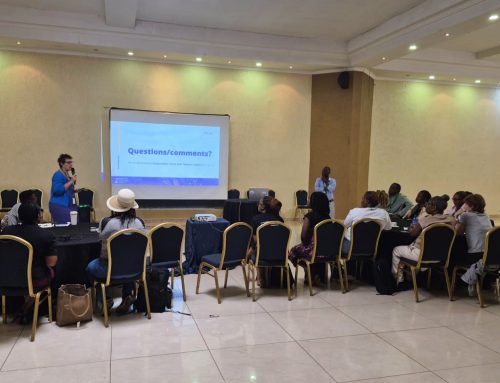
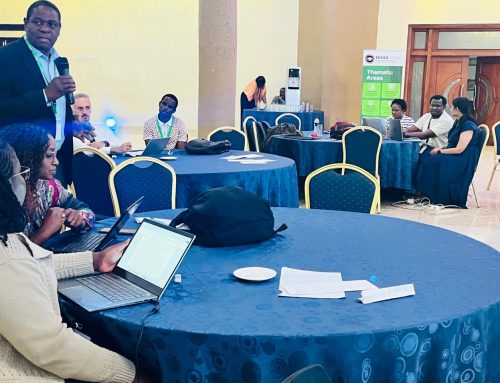
JHUB Africa team ©Kelvin Mwangi and Brian Muriithi, JHUB
The Sub-Saharan Africa Teacher Leadership for ESD team is working with JHUB Africa to foster sustainable development in Kenya and at pan-Africa level.
JHUB Africa is a university-anchored digital innovation, research translation, and enterprise development hub based at Jomo Kenyatta University of Agriculture and Technology (JKUAT). It was established in 2024 to transform advanced knowledge in computing, artificial intelligence, data science, software engineering, the Internet of Things, digital systems, and emerging technologies into practical solutions for societal, institutional, industrial, and community challenges. Its central philosophy is that innovation must move beyond academic demonstration and classroom experimentation into validated, user-centred, deployable, and scalable solutions that respond to real needs.
JHUB Africa serves as a bridge connecting research, talent, industry, government, communities, and entrepreneurship. It provides a structured environment in which students of JKUAT, researchers, innovators, partners, and clients co-create solutions that address Africa’s development priorities in areas such as health, agriculture, education, climate resilience, digital public infrastructure, MSME transformation, responsible artificial intelligence, and local-language technologies. Its work is therefore not merely technical; it is developmental, interdisciplinary, inclusive, and impact-oriented.
At its core, JHUB Africa advances an innovation model in which every project is connected to a real user, customer, institution, or community need. Through this approach, the hub cultivates not only technical competence, but also systems thinking, ethical reasoning, product discipline, entrepreneurial capability, and social responsibility.
JHUB Africa also functions as a strategic platform for developing Africa’s next generation of digital innovators. It brings together multidisciplinary student teams from computing, engineering, agriculture, health sciences, business, communication, project management, and design to work on high-value innovation challenges. Through this model, students do not simply learn how to use technology; they learn how to define problems, engage stakeholders, establish requirements, design and test prototypes, manage projects, communicate value, protect intellectual property, and transition promising solutions towards adoption and scale.

Students of JKUAT ©Kelvin Mwangi and Brian Muriithi, JHUB
This role is exemplified through JHUB Africa’s support for JKUAT’s participation in the Sub-Saharan Africa Teacher Leadership for Education for Sustainable Development (SSATL-ESD) project, where digital innovation, capacity building, and collaborative communities of practice are used to advance Education for Sustainable Development. The hub helps build the capacity of teacher educators on addressing real environmental, social, and educational challenges while strengthening green and digital competencies. By supporting co-creation, documentation, monitoring, knowledge sharing, and dissemination, JHUB Africa helps promising interventions progress from training and experimentation towards sustained institutional and community impact.
Dr Lawrence Nderu, Senior Lecturer, Department of Computing at JKUAT and co-Principal Investigator of the SSATL-ESD project, is the founder of JHUB Africa. On advancing the ESD agenda of the JHUB, Dr Nderu says:
“The hub’s contribution to the SSATL-ESD Programme reflects its broader commitment to responsible innovation and sustainable development. By combining digital tools with participatory learning, institutional leadership, and evidence based implementation, JHUB Africa supports solutions that are not only technologically sound but also contextually relevant. This approach reinforces the role of universities as active catalysts for sustainable transformation.”
In a broader sense, JHUB Africa represents a new model of the African university: one that is not only a producer of graduates and publications but also a producer of solutions, ventures, datasets, digital public goods, intellectual property, and innovation capacity. It positions JKUAT as an active participant in Africa’s digital and sustainable transformation by connecting academic excellence with practical implementation. Its ambition is to become a continental reference point for responsible, inclusive, sustainable, and impact-driven digital innovation.
For any further information, contact Dr Nderu at lnderu@jkuat.ac.ke
Note: The text of this article has been developed by the JHUB Africa team using generative AI.
About the Sub-Saharan Africa Teacher Leadership for ESD Project
This project is led by Leuphana University and co-funded by the European Commission. The project makes an important contribution to SDG 4.7 through building capacity in teacher trainers on ESD leadership.
Should you have any further questions, please write to unescochair@leuphana.de