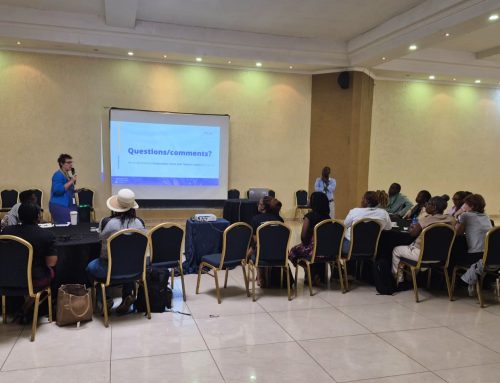
Participants discuss ways of connecting project experience with education policy during the SSATL-ESD Policy Dialogue Preparation Lab at EEASA 2026 in Lilongwe, Malawi. ©Ben de Souza.
What does it take for a promising idea in teacher education to influence the policies that govern it?
This question brought researchers, teacher educators and education practitioners together on 23 September 2026 at the 44th Environmental Education Association of Southern Africa (EEASA) Conference in Lilongwe, Malawi, for the preparation lab under the policy dialogue of Sub-Saharan Africa Teacher Leadership for ESD project.
Part of the session “Teacher Leadership for Transformative ESD in African Higher Education”, the lab explored how lessons from Education for Sustainable Development (ESD) initiatives can inform decisions in institutions and education systems. Tiffany Banda, Manoah Muchanga, Caleb Mandikonza, Charles Chikunda and Ben de Souza contributed to the session, with Dr Charles Chikunda facilitating the lab.
Instead of beginning with project achievements, participants were invited to ask what those achievements reveal. Training educators is necessary, but what does it tell us about the support teachers need, the barriers they face or the policies that could help them lead change? The main intent was to understand how best to take the messages from ESD implementation to the policy level and how ESD can be embedded into education policies.
In small groups, participants worked through practical activities that connected experience with policy questions. They identified policy and implementation challenges related to youth participation in education and policymaking and mapped the decision-makers, practitioners, researchers and affected communities relevant to addressing these challenges. The exercises also introduced a short evidence pitch and a planning tool covering the purpose of a dialogue, the evidence to present, the questions to ask and the responsibilities for follow-up.
A policy dialogue simulation invited participants to step into the roles of policymakers, project leaders, practitioners, researchers and community representatives. The exercise drew attention to an important difference: policy dialogue is not simply presenting project results. It brings people with different responsibilities together to examine evidence, understand an issue and discuss practical responses.
The workshop reflected the wider ambitions of SSATL-ESD, an Erasmus+ co-funded Euro-African partnership coordinated by Leuphana University in Lüneburg, Germany. Working with partner institutions in South Africa, Zambia, Namibia, Malawi, Kenya, Cyprus and Greece, the project supports teacher leadership through professional development, institutional change projects and opportunities for cross-country learning. The aim is to help educators turn sustainability education into meaningful changes in teaching, learning and institutional practice.
At EEASA 2026, participants drew on experiences from their own education settings to explore how closer engagement with policy actors could support ESD initiatives. The lab offered a clear message: evidence from local practice can help shape education policy when the people who generate it, implement decisions and experience their effects have a place in the conversation.
About the Sub-Saharan Africa Teacher Leadership for ESD Project
This project is led by Leuphana University and co-funded by the European Commission’s Erasmus+ programme. It is also supported by regional partners and African universities who are offering co-funded support and support in kind for dimensions of the programme not costed into the EU budget. The project makes an important contribution to SDG 4.7 through building capacity in teacher trainers on ESD leadership.
Should you have any further questions, please write to unescochair@leuphana.de