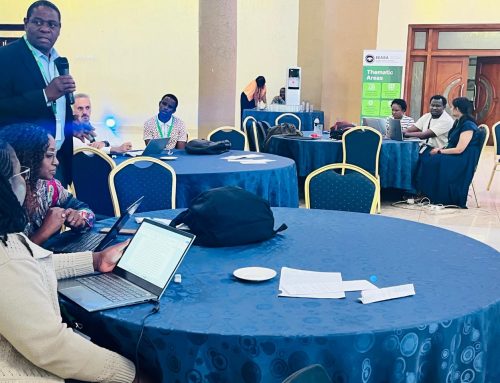
Participants engage in the SSATL-ESD workshop on climate-conscious education and teacher-led Change Projects at EEASA 2026 in Lilongwe, Malawi. ©Caleb Mandikonza
A more sustainable future for education can begin with a small change: a lesson redesigned, a colleague included into a conversation or a new approach tested with students. But how can such efforts grow into a change across an institution? That question was at the heart of an interactive Sub-Saharan Africa Teacher Leadership (SSATL-ESD) workshop at the 44th Environmental Education Association of Southern Africa (EEASA) Conference in Lilongwe, Malawi, on 24 September 2026. The EEASA conference is an annual meeting that brings together environment educators, sustainability practitioners and sustainable development stakeholders to share knowledge and ideas on how to foster human development through environmental and sustainability education.
Under the theme “Cultivating Climate-Conscious Educators”, Ben de Souza, Charles Chikunda and Heila Lotz-Sisitka from Rhodes University, South Africa introduced participants to the concept of teacher leadership and role of communities of practice in advancing Education for Sustainable Development (ESD). The discussion focused on how teacher leaders can work together and generate some understanding of their role in responding to climate and other sustainability challenges through changes in teaching, learning and institutional practice.
Central to the workshop was the ESD teacher leaders change project: an initiative developed by educators with colleagues in their respective universities to address a sustainability concern in their own setting. A change project in this context is known as a practical initiative designed to address an identified challenge by applying new knowledge, skills and collaborative approaches to bring about meaningful and sustainable improvements. The participants explored key questions on what kind of teacher leadership is required to implement the change projects with other peers. The idea or notion that leadership need not sit with one person and therefore everyone has the potential to spearhead change. In a community of practice, lecturers, students, institutional leaders and community partners can contribute different skills, learn from each other and share responsibility for change.
The approach follows a simple invitation: “Start small, think big, and act now.” A change project might involve rethinking a teacher education module, introducing participatory learning activities, building student-led sustainability initiatives or bringing sustainability into institutional policies. What matters is that the project responds to a real local need or a sustainability challenge, connects with institutional priorities and creates opportunities for people to learn and act together.
The session also outlined the SSATL-ESD action-learning pathway as adopted in the SSATL ESD project, which is in its second year of implementation in five countries in Africa, including Kenya, Malawi, Namibia, South Africa and Zambia. In the project, the educators begin by examining their context and shaping a shared project idea. They then test transformative teaching approaches, consider assessment that values collaboration and well-being, and review what their work has achieved and how it could be strengthened or taken further. Participants discussed how these ideas could be adapted to universities, teacher education programmes and national contexts across the region to strengthen ESD.
The workshop was part of SSATL-ESD, an Erasmus+ co-funded Euro-African partnership coordinated by Leuphana University in Lüneburg, Germany. With institutions in South Africa, Zambia, Namibia, Malawi, Kenya, Cyprus and Greece, the project combines professional development, institutional change projects and a cross-border network of teacher educators for shared learning. The conversations in Lilongwe pointed to the promise of this approach: climate-conscious education grows when educators have the confidence, relationships and institutional support to turn ideas into action. These conversations came at a time that a recent policy analysis done in Africa has shown that there is a need to put more efforts on building capacity for teacher leadership in ESD.
About the Sub-Saharan Africa Teacher Leadership for ESD Project
This project is led by Leuphana University and co-funded by the European Commission’s Erasmus+ programme. It is also supported by regional partners and African universities who are offering co-funded support and support in kind for dimensions of the programme not costed into the EU budget. The project makes an important contribution to SDG 4.7 through building capacity in teacher trainers on ESD leadership.
Should you have any further questions, please write to unescochair@leuphana.de